Introduction 7
Part 1: The Archetypal Big Debt Cycle 9
How I Think about Credit and Debt 9
The Template for the Archetypal Long-Term/Big Debt Cycle 13
Our Examination of the Cycle 13
The Phases of the Classic Deflationary Debt Cycle 16
-The Early Part of the Cycle 16
-The Bubble 16
-The Top 21
-The "Depression" 23
-The "Beautiful Deleveraging" 32
-"Pushing on a String" 35
-Normalization 38
Inflationary Depressions and Currency Crises 39
The Phases of the Classic Inflationary Debt Cycle 41
-The Early Part of the Cycle 41
-The Bubble 42
-The Top and Currency Defense 45
-The Depression (Often When the Currency Is Let Go) 49
-Normalization 54
The Spiral from a More Transitory Inflationary
Depression to Hyperinflation 58
War Economies 61
In Summary 64
PART 2: Detailed Case Studies
German Debt Crisis and Hyperinflation (l918-1924}
US Debt Crisis and Adiustment (1928-1937)
US Debt Crisis and Adiustment (2007-2011)
PART 3: Compendium of 48 Case Studies
Glossary of Key Economic Terms
Primarily Domestic Currency Debt Crises
Non-Domestic Currency Debt Crises
Appendix: Macroprudential Policies
· · · · · · (收起)
具體描述
"Ray Dalio's excellent study provides an innovative way of thinking about debt crises and the policy response." - Ben Bernanke
"Ray Dalio's book is must reading for anyone who aspires to prevent or manage through the next financial crisis." - Larry Summers
"A terrific piece of work from one of the world's top investors who has devoted his life to understanding markets and demonstrated that understanding by navigating the 2008 financial crisis well." - Hank Paulson
"An outstanding history of financial crises, including the devastating crisis of 2008, with a very valuable framework for understanding why the engine of the financial system occasionally breaks down, and what types of policy actions by central banks and governments are necessary to resolve systemic financial crises. This should serve as a play book for future policy makers, with practical guidance about what to do and what not to do." - Tim Geithner
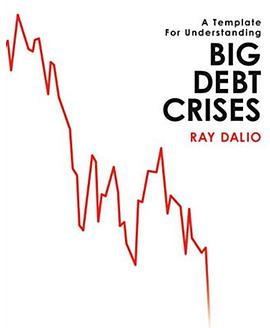
On the 10th anniversary of the 2008 financial crisis, one of the world's most successful investors, Ray Dalio, shares his unique template for how debt crises work and principles for dealing with them well. This template allowed his firm, Bridgewater Associates, to anticipate events and navigate them well while others struggled badly.
As he explained in his #1 New York Times Bestseller, Principles: Life & Work, Dalio believes that most everything happens over and over again through time so that by studying their patterns one can understand the cause-effect relationships behind them and develop principles for dealing with them well. In this 3-part research series, he does that for big debt crises and shares his template in the hopes reducing the chances of big debt crises happening and helping them be better managed in the future.
The template comes in three parts provided in three books: 1) The Archetypal Big Debt Cycle (which explains the template), 2) 3 Detailed Cases (which examines in depth the 2008 financial crisis, the 1930's Great Depression, and the 1920's inflationary depression of Germany's Weimar Republic), and 3) Compendium of 48 Cases (which is a compendium of charts and brief descriptions of the worst debt crises of the last 100 years). Whether you're an investor, a policy maker, or are simply interested, the unconventional perspective of one of the few people who navigated the crises successfully, A Template for Understanding Big Debt Crises will help you understand the economy and markets in revealing new ways.
用戶評價
##Simply the best hypothesis, and proven.
評分##Simply the best hypothesis, and proven.
評分##先讀為敬
評分##Simply the best hypothesis, and proven.
評分##沒時間的話主要讀第一部分和2007-2008的案例就好瞭,可是人類什麼時候會從中吸取教訓呢?
評分##囫圇吞棗的第一遍
評分##Simply the best hypothesis, and proven.
評分##囫圇吞棗的第一遍
評分##隻有第一章細細看過,後麵第二章和第三章的例子就沒怎麼細看瞭。結閤剛剛看過的《第二次啓濛》還挺有貫通感:總的來說,大概所有的cycles都是因人類自己的短視而導緻的,而人的短視基本上還是因為人類的短命(想象一下,如果我能活一韆年,那我對於用未來二十年的痛苦來換取未來兩百年的幸福會怎麼想)。在這個基礎上,所有的機製都有自己的矛盾和缺陷。而在一種無奈的囚徒睏境下,個人隻能看自己這短暫的一生恰好是在一個cycle的上升繁榮期還是下降衰退期,而能夠靠自己能力改變的真的不多。