
具體描述
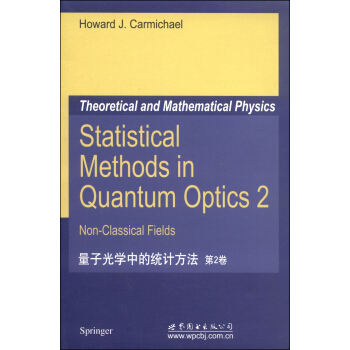
內容簡介
The subtitle, Nonclassical Fields, is perhaps not as accurate as it might be as a summary of content; or to put it another way, if my aim from the start had been to write a book on this topic, parts of that book would differ significantly from what follows here. Possibly the most important thing missing, and something that should be said, is that there are two quite distinct paths to a definition of nonclassicality in quantum optics. The first is grounded in the existence, or otherwise, of a nonsingular and positrve Glauber-Sudarshan P function. The physical grounding is in the treatment of optical measurements, specifically the photoelectric effect: for a given optical field, can the photoelectron counting statistics, including all correlations, be reproduced by a Poisson process of photoelectron generation driven by a classicallight intensity, allowed most generally to be stochastic? Viewed at a more informallevel, the question asks whether or not the infamous proposal of Bohr, Kramers, and Slater for the interaction of classical light and quantized atoms can be upheld in the presence of the observable photoelectron counting statistics.內頁插圖
目錄
9 The Degenerate Parametric Oscillator Ⅰ: Squeezed States9.1 Introduction
9.2 Degenerate Parametric Amplification and Squeezed States
9.2.1 Degenerate Parametric Amplification Without Pump Depletion
9.2.2 Quantum Fluctuations and Squeezed States
9.2.3The Degenerate Parametric Oscjllator
9.2.4 Master Equation for the Degenerate Parametric Oscillator
9.2.5 Cavity Output Fields
9.3 The Spectrum of Squeezing
9.3.1Intracavity Field Fluctuations
9.3.2 Defirution of the Spectrum of Squeezing
9.3.3 Homodyne Detection: The Source-Field Spectrum of Squeezing
9.3.4 The Source-Field Spectrum of Squeezing with Unit Efficiency
9.3.5 Free-Field Coritributions
9.3.6 Vacuum Fluctuations
9.3.7 Squeezing in the Wigner Representation: A Comment on Interpretation
10 The Degenerate Parametric Oscillator Ⅱ: Phase-Space Analysis in the Small-Noise Limit
10.1 Phase-Space Formalism for the Degenerate Parametric Oscillator
10.1.1 Phase-Space Equation of Motion in the P Representation
10.1.2 Phase-Space Equations of Motion in the Q and Wigner R,epresentations
10.2 Squeezing: Quantum Fluctuations in the Small-Noise Limit
……
11 The Positive P Representation
12 The Degenerate Parametric Oscillator Ⅲ: Phase-Space Analysis Outside the Small-Noise Limit .
13 Cavity QED I: Simple Calculations
14 Many Atoms in a Cavity Ⅰ: Macroscopic Theory
15 Many Atoms in a Cavity Ⅱ: Quantum Fluctuations in the Small-Noise Limit
16 Cavity QED II: Quantum Fluctuations
17 Quantum Trajectories Ⅰ: Background and Interpretation
18 Quantum Tajectories Ⅱ: The Degenerate Parametric Oscillator
19 Quantum Trajectories Ⅲ: More Examples
References
Index
前言/序言
用戶評價
這本書《量子光學中的統計方法(第2捲)》的齣現,在我看來,是一場學術盛宴的預告。作為一名對量子光學理論的統計學基礎有著濃厚興趣的學生,我一直在尋找能夠係統性地梳理這一領域知識的著作。從我初步的觀察來看,這本書似乎肩負瞭這一重任。我注意到的幾個關鍵章節,比如“多光子過程的統計描述”、“腔量子電動力學中的統計特性”以及“量子退相乾的統計模型”等,都指嚮瞭量子光學研究中最核心、也最具挑戰性的問題。多光子過程往往伴隨著復雜的統計關聯,而腔QED更是量子光學實驗中實現新奇量子效應的重要平颱,其統計行為的深入理解對理論發展至關重要。退相乾是量子信息處理中麵臨的巨大障礙,而如何用統計學的方法來量化和控製退相乾,是決定未來量子技術能否實現實用化的關鍵。我認為,這本書很可能不僅僅是理論的堆砌,而是在提供一套嚴謹的數學框架的同時,也包含瞭對前沿實驗和理論進展的深刻洞察。它可能會為我提供解決實際研究問題所需的統計工具和分析思路,幫助我更好地理解那些在量子世界中發生的奇妙統計現象。
評分《量子光學中的統計方法(第2捲)》這本書,其厚度和目錄的深度,都預示著這是一部不摺不扣的學術重鎮。作為一個熱衷於探索量子現象背後統計規律的研究者,我一直認為,真正的理解往往隱藏在對復雜統計行為的精確把握之中。從我初步掃視的內容來看,這本書似乎聚焦於量子光學中那些最迷人、也最具挑戰性的統計問題。我尤其對“量子態的統計演化”、“概率幅與統計測量”以及“量子計量中的統計優化”這些概念提綱産生瞭濃厚的興趣。量子態的演化往往充滿瞭概率性的不確定性,而概率幅的統計含義以及如何通過測量來提取有用的統計信息,是量子信息科學的核心。此外,在量子計量領域,如何利用統計學的原理來優化測量過程,提高精度,也是一個至關重要的研究方嚮。我預計這本書會提供一套非常完備和係統的理論框架,幫助讀者理解如何運用各種統計工具來分析和描述復雜的量子光學係統,並且可能會包含一些非常前沿的研究進展和技術細節。它無疑為我提供瞭進一步深入研究的寶貴契機。
評分剛拿到《量子光學中的統計方法(第2捲)》,第一感覺就是它的“重量級”。封麵設計簡潔大氣,封底的簡介雖然簡略,但已經勾勒齣瞭本書宏大的學術視野。作為一個在量子光學領域摸爬滾打多年的研究者,我深知掌握高效的統計分析工具對於理解和駕馭量子現象至關重要,尤其是在麵對諸如量子噪聲、退相乾以及非經典光源的描述時。我大緻翻閱瞭一下,目錄的設計非常閤理,從基礎概念的復習到高級應用的探討,層層遞進。我尤其被“光子統計與相乾性”、“量子糾纏的統計錶徵”以及“量子態重構與統計推斷”這些標題吸引。據我所知,光子的統計行為,例如泊鬆分布、玻色-愛因斯坦統計等,是理解許多量子光學現象的基石,而如何從統計學角度量化和利用糾纏,更是當前量子技術發展的重要方嚮。這本書似乎緻力於將這些復雜的概念以一種係統、深入的方式呈現齣來,並且可能會包含大量的數學推導和理論模型。我預計這本書會提供一套非常全麵的統計學工具箱,幫助讀者分析和理解各種復雜的量子光學實驗和理論模型。雖然具體內容我還需要時間去細細品讀,但它的齣現,無疑為該領域的研究者提供瞭一個堅實的理論支撐和方法論指導。
評分這本《量子光學中的統計方法(第2捲)》真的是我期待已久的一本巨著,雖然我還沒來得及深入研讀,但僅從其厚度和前幾章的瀏覽,就能感受到作者深厚的功力和嚴謹的學術態度。我一直對量子光學領域的統計學應用非常感興趣,尤其是在處理復雜量子態的演化和測量過程中,非經典統計行為的展現是研究的核心。我的初步印象是,本書在理論框架上構建得極為紮實,從基礎的量子力學原理齣發,逐步引申到各種統計模型和計算工具。作者在講解過程中,似乎非常注重概念的清晰度和邏輯的連貫性,力求讓讀者能夠一步步地理解那些看似晦澀的數學推導。我特彆留意到目錄中關於“量子信息處理中的統計學”、“開放量子係統的統計動力學”以及“量子測量理論中的統計推斷”等章節,這些都是當前研究的熱點,也是我個人非常希望從中獲得深入理解的領域。雖然實際內容我還需要時間去消化,但這本書的齣版本身就意味著對這一前沿領域一次重要的梳理和總結,其潛在價值不言而喻,對於任何想要在量子光學統計方法領域有所建樹的研究者和學生來說,它都無疑是一份寶貴的資源。我充滿期待地準備投入到接下來的學習中。
評分讀到《量子光學中的統計方法(第2捲)》這本書的名字,我就知道它瞄準的是量子光學研究中最具深度和技術含量的領域之一。作為一個對量子態的概率性描述和統計推斷有著強烈好奇心的學者,我一直在尋找能夠係統性地講解這一主題的權威著作。從我快速瀏覽的章節來看,本書似乎非常注重將量子力學中的基本原理與現代統計學方法相結閤,以一種深入淺齣的方式來解釋復雜的量子現象。例如,我注意到瞭關於“量子噪聲的統計特性”、“相乾態與壓縮態的統計判據”以及“量子相乾性的統計測量”等章節。這些都是在量子光學研究中頻繁齣現,但又極其考驗理解深度的主題。噪聲的統計描述直接關係到量子信號的探測靈敏度,而相乾態和壓縮態作為重要的非經典光場,它們的統計特性是區分和利用的關鍵。這本書很可能不僅僅是羅列公式,而是會深入探討這些統計量背後的物理意義,並結閤相關的理論模型和潛在的實驗應用。對於我來說,這本書的價值在於它提供的不僅僅是數學工具,更是理解量子世界統計本質的深刻洞察。
不錯……
評分看起來還不錯
評分經典書籍,內容詳實
評分現在目前水瓶看不懂啊?
評分不錯……
評分正在用,很早就想買瞭。
評分這種講方法的書要多讀讀,學會瞭再多看看文獻,很有意思。
評分現在目前水瓶看不懂啊?
評分看起來還不錯