
具体描述
内容简介
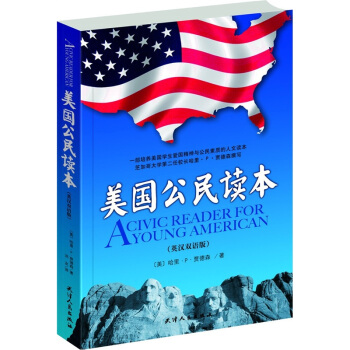
《美国公民读本(英汉双语版)》是美国著名教育家、历史学家,芝加哥大学第二任校长哈里·P·贾德森教授为美国教师和学生写作的一本通俗公民读本。它具有双重功能:一方面让学生通过此书得到阅读训练,同时让他们从书中获取更多知识。作为一本公民读本,书中对爱国精神、公民权利与自由、政府机构及其运行、财政税收、公共管理等进行了阐述。当然作者写作此书的本意并非构建一部公民学或历史学的大作,而是一种通俗普及读本。在讲述这些知识时,当然会涉及美国历史,因为书中概括的这些公民常识,都是历史地、动态地形成的,每一个都渊源有自、可成为案例援引。书中各章节还插入了与该时期历史文化相关的美国名家笔下的文学篇章。让本书内容更加丰富而具可读性。
正如作者所言:"写作此读本,旨在向读者传授纯粹的爱国精神与公民智慧。"国内出版的双语版,也本着两个目的:一是让学生通过阅读,英文水平得到提高;二是拓宽其知识和视野,成为一位卓越的世界公民。
作者简介
作者:(美国)哈里?P?贾德森 译者:洪友 哈里?P?贾德森(1849-1927)美国著名教育家和历史学家、芝加哥大学第二任校长,其研究方向主要为宪法和外交史。 贾德森出生于纽约詹姆斯镇,毕业于威廉姆斯学院,后从事教育工作,1885-1892年在明尼苏达大学担任历史学与教育学教授,后任芝加哥大学政治科学教授兼系主任,以及艺术、文学与科学系教授兼系主任。 芝加哥大学创始人兼校长威廉?哈珀欣赏贾德森教授广博的研究领域与治学风格,邀他加入芝加哥大学。贾德森教授也被哈珀校长卓越的教育规划所吸引。1892年,贾德森从明尼苏达大学来到芝加哥大学,帮助组建芝加哥大学的教育体系与规划,与哈珀共同领导和管理芝加哥大学。1906年哈珀去世,贾德森接任校长,直至1923年退休。 贾德森教授写作了不少著作,除学术之作外,他还为美国学生编写了一些经典读物,如《美国公民读本》和《美国学生文学读本》(1-8级)等。内页插图
目录
CHAPTER I Our Country
CHAPTER II The Republic
CHAPTER III Laws and Their Makers
CHAPTER IV What We Mean by Government
CHAPTER V How the People of Europe Found America and Came to Live in It
CHAPTER VI National Independence
CHAPTER VII A Federal Republic
CHAPTER VIII American Home Rule
CHAPTER IX The Law-Makers
CHAPTER X How Laws Are Enforced
CHAPTER XI The President's Cabinet
CHAPTER XII How Laws Are Enforced in the States
CHAPTER XIII Judge and Jury
CHAPTER XIV How the Government Gets Money
CHAPTER XV Who We Are
CHAPTER XVI Who Are Our Rulers
APPEND A Brief Account of the Constitution of the United States
PART II 中文阅读
CHAPTER 01 我们的祖国
CHAPTER 02 共和国
CHAPTER 03 法律和立法者
CHAPTER 04 政府对我们的地位是怎样界定的
CHAPTER 05 欧洲人怎样发现美洲并迁居于此
CHAPTER 06 民族独立
CHAPTER 07 一个联邦制的共和国
CHAPTER 08 美国的地方自治
CHAPTER 09 立法者
CHAPTER 10 法律是怎样执行的
CHAPTER 11 总统内阁
CHAPTER 12 法律在各州是怎样执行的
CHAPTER 13 法官和陪审团
CHAPTER 14 政府怎样筹钱
CHAPTER 15 我们是谁
CHAPTER 16 谁统治我们
精彩书摘
CHAPTER I Our Country
1. Why We Love Our Country. Every good American citizen loves his country and is proud of it. We have very good reasons both for the love and for the pride. Ours is one of the greatest nations of the world, in area of territory, in number of people, in wealth and in power. We also think that the citizens of the great republic are among the most intelligent in the world. Free public schools make it possible for every one to get some sort of an education, and books and newspapers are found in every home. But better still is the liberty which we enjoy. We have no king or emperor to rule over us. We choose our own officers of state, who, indeed, are not our rulers, but are merely public servants. In some countries the police are constantly interfering with people. A public meeting cannot be held without the consent of the police. The police watch the hotel registers and keep careful track of all strangers. If a club or a debating society is formed, the police have to be notified. Then, too, every young man has to spend several years as a soldier-for most of the nations of Europe keep vast armies always ready for war. Now, with us the policeman and the soldier are much less prominent. As long as one is not a thief or some other sort of criminal, the police let one quite alone. And no one in our country needs to be a soldier at all. Our few soldiers are all volunteers. In short, we live in a free land, in which every one may live his life in his own way, so long as he does not interfere with the rights of his neighbors.
2. These are some reasons for loving our country. There are many other reasons too, but perhaps these are enough to show what we mean. Still, it may be as well to add one more-it is our home. There are few words dearer to any genuine man or woman than home. But just as the home is the center of the life of the family, so our country is the center of the nation's life. It is our home land-the land of our fathers and mothers, of our brothers and sisters. And he is a poor ingrate who does not dearly love his home.
3. What We Mean by a Patriot. A patriot is one who loves his fatherland-his country. People show patriotism in various ways. In time of war, when the national safety is menaced by a public enemy, men are ready to enter the army and to give their lives, if need be, in defense of their country. A true patriot, too, is pleased by everything which reflects credit on his homeland. He is anxious that its public affairs shall be stained with no meanness or dishonor. He is anxious that its government shall always be just and generous in dealing with the governments of other nations. He does not wish an advantage secured from any other nation, especially from a weaker one, by wanton violence or by fraud. He is delighted with every advance of his country in the arts of civilization, and pained at the triumph of evil men or of vicious measures. And he is always ready to do what he can to make his country better or stronger or safer.
4. What a Patriot is Not. We have seen some of the reasons which an American has for being proud of his country. But in order to be a patriot it is not at all necessary to be a boaster. Indeed, a true patriot is so sure of the solid merit of his country that he does not need to say much about it. If a man is in the habit of talking about his own honesty, it leads others to suspect that perhaps after all he is trying to cover up a streak of dishonesty. At any rate, bragging is a weak and foolish habit. And bragging of one's country is quite as foolish as it is for a boy to boast of his father's wealth or of his sister's beauty.
5. Neither is it a sign of patriotism to despise other countries. We may love our own the best, but one who does not know that other countries also are great and powerful and famous, is merely very ignorant. If we respect other nations for their good qualities, we are all the better fitted to understand and admire the like qualities in our own.
6. Sneering at other races is no sign of patriotism. Boys and girls sometimes are apt to think themselves better than one of their mates who was born in a foreign land, and to show their superiority by using for him some sort of foolish nickname. But this is very silly. Is he a German? The Germans have some of the greatest names and have done some of the greatest deeds in all history. Is he an Italian? Italy is a beautiful land, famous for some of the finest painters and musicians, and for some of the wisest statesmen and the bravest soldiers of any land. Is he a Jew? They are a wonderful people, and a list of the great men who are Jews would be a very long one. Indeed, one may well be glad and proud to belong to any of these races, or of many others which might be mentioned.
7.What a Patriot Should Know. It is not enough for a patriot to think that his country is a very good and comfortable land. No opinion is worth much unless it comes from actual knowledge. It is a very commonly observed fact that the more ignorant people are, the more they are stuffed with prejudices. But prejudice is merely a strong opinion which is formed with a very scanty basis of knowledge. Now, in fact, no opinion is worth much, as we said, unless it belongs to one who knows what he is talking about. A jeweler who has spent all his life in a city, probably would not know much about farming. If, then, he should go into the country and begin giving a farmer advice about the management of his crops, the farmer would laugh at him. The jeweler's opinion about repairing a watch would doubtless be better than the farmer's, but, on the other hand, the farmer would be apt to know more about planting corn. In other words, it is knowledge that gives an opinion its value.
8. Then, our opinions about our country are not worth very much unless we know something of its history. We ought to know how it is governed, how the laws are made, how they are enforced, what the courts are and how they do their work, what are the rights of a citizen and what are not his rights. We ought to know how our country came to be what it is, who are some of the great men it has produced, and what they have done. With some of this knowledge our opinions are much less likely to be mere prejudices.
9. There is another important reason for knowing something about the way in which our country is governed. With us about every man of full age, that is, twenty-one years old or over, is a voter. The most of all public officers are elected. And a voter is not very useful whose ideas of what he is voting for are in a fog. He is easily led by shrewd and unscrupulous demagogues; he is simply a tool, a slave. It is often said that knowledge is power. We might add that knowledge of public affairs is liberty.
10. The Flag. Every nation has a flag of its own, with an appropriate combination of colors and symbols. This flag flies from the mast of a ship on the ocean, thus indicating at once to what country she belongs. The flag is raised on a staff in forts and military, camps, is carried by soldiers on the march and in battle, and is used very commonly by people in token of their patriotism. On the Fourth of July we see the American flag everywhere, and it is the custom now in many parts of the country to keep it floating over the school-houses whenever school is in session. The American flag has thirteen horizontal stripes, seven red and six white. In the upper corner, next the staff, is a blue square filled with white stars. The thirteen stripes indicate the thirteen original states, and the stars show the number of states. When a new state is admitted, on the next Fourth of July a new star is added to the flag.
11. There are now forty-five states in the Union. But no flag made before July 4, 1896, should have more than forty-four stars. Utah became a state January 4, 1896. Every flag hoisted over a national fort or ship or building, on the third of July, 1896, had forty-four stars, showing the number of states on the Fourth of July, 1895, but on the morning of the Fourth of July, 1896, every such flag should have had forty-five stars.
12. How a Famous Song Was Written. During the second war with England, in 1814, a British expedition attempted to capture the city of Baltimore. In order to do that it was necessary first to reduce Fort McIIenry, and so the warships moved up near it and opened a heavy fire of cannon-balls, bomb-shells, aud rockets.① During the battle a small party of Americans, carrying a flag of truce, went out to the British fleet in order to secure the release of an American citizen who had been taken prisoner. One of the party with the flag of truce was Francis Scott Key. The business being finished, the Americans were detained overnight in the fleet, far to the rear of the attack, in order that they might not be able to give information of what they had seen. The bombardment went on long after dark, and Mr. Key eagerly listened to the sound of the guns and watched the red rockets and the bursting bombs, being sure as long as the firing continued that the fort still held out. But late in the night the guns became silent. Did it mean that the attack had been repulsed? Or had the fort surrendered? Only the daylight would tell. Before dawn the anxious Americans were watching. The first faint light of day showed them the stars and stripes still floating over the ramparts of the fort. Then they knew that the attack had failed and that the Americans were victorious. Mr. Key walked the deck in deep emotions of joy, and gave vent to his feelings in the verses of a patriotic song. These he scribbled on a scrap of paper which he found in his pocket. On reaching land he gave his song to a friend, and it was sung at a theater in Baltimore, the singer waving a flag as she sang. The audience were wild with enthusiasm. In a very short time the new song went all over the republic, and is now known and loved by all Americans. It is called "The Star-Spangled Banner."
13. The Storm at Samoa. In the spring of 1889 there was trouble at the island of Samoa, in the South Pacific, and warships were sent there by Germany, Great Britain, and the United States. These vessels lay at anchor in the harbor of Apia. The harbor is a small semi-circular bay, with shoal water extending far from the shore and a coral reef running nearly across the entrance. A narrow break in the reef allows ships to enter the bay. One day in March a heavy storm came up. So fierce was the wind and so tremendous the waves that the vessels dragged their anchors, and one after another four warships and ten other craft were driven on shore and wrecked. Nearly a hundred fifty of the seamen lost their lives. In the fury of the hurricane the captain of the British ship Calliope decided to leave the harbor and force his way out to sea, as the only means of safety from shipwreck. All steam was put on, and inch by inch the gallant ship fought its way in the teeth of the howling wind and the crashing waves. "This manoeuver of the British ship is regarded as one of the most daring in naval annals. It was the one desperate chance offered her commander to save his vessel and the three hundred lives aboard. An accident to the machinery at this critical moment would have meant certain death to all. To clear the harbor the Calliope had to pass between the Trenton (the American flagship) and the reef, and it required the most skilful seamanship to avoid collision with the Trenton, on the one hand, or total destruction upon the reef, on the other. The Trenton's fires had gone out by that time, and she lay helpless almost in the path of the Calliope. The doom of the American flagship seemed but a question of a few hours. Nearly every man aboard felt that his vessel must soon be dashed to pieces, and that he would find a grave under the coral reef. The decks of the flagship were swarming with men, but, facing death as they were, they recognized the heroic struggle of the British ship, and as the latter passed within a few yards of them a great shout went up from over four hundred men aboard the Trenton. 'Three cheers for the Calliope!' was the sound that reached the ears of the British tars as they passed out of the harbor in the teeth of the storm; and the heart of every Englishman went out to the brave American sailors who gave that parting tribute to the Queen's ship. The English sailors returned the Trenton's cheer, and the Calliope passed safely out to sea, returning when the storm had abated. Captain Kane, her commander, in speaking of the incident, afterward said: 'Those ringing cheers of the American flagship pierced deep into my heart, and I shall ever remember that mighty outburst of fellow-feeling which, I felt, came from the bottom of the hearts of the gallant admiral and his men. Every man on board the Calliope felt as I did; it made us work to win. I can only say, 'God bless America and her noble sailors!'"① They were thrilled with admiration for the dauntless courage of the brave British seamen on the Calliope; and in their own extremity they showed equal courage. Twice England has been our enemy in war. But, after all, in peace we cannot forget that Englishmen and Americans are of one blood. Late in the day, when ship after ship had been dashed to destruction, and the Trenton, shattered and helpless, seemed drifting to certain wreck, the anxious people on the beach heard music amid the roar of the hurricane. It was the band of the Trenton playing "The Star-Spangled Banner." The gallant sailors were facing death with the national music in their ears and its ringing words in their thoughts. It carried their minds back to the homeland which they loved and for which they were ready to die.
14. Another Poem About the Flag. Joseph Rodman Drake was a young American poet of great promise. His early death (he died in 1820, at the age of twenty-five) came before he had fully shown his rare powers. When he was only seven years old he had much literary knowledge, and at fourteen he had already written poetry of good quality. His principal poems were "The Culprit Fay" and the stirring stanzas on "The American Flag."
……
前言/序言
用户评价
我得说,这本书的语言风格对于非英语母语的学习者来说,简直是一股清流。很多同类的双语读物,要么是英文部分过于艰涩,要么是中文翻译过于口语化,导致学习体验断裂。但这本书的英文部分用词考究,句子结构清晰流畅,完全是地道的学术或新闻报道用语水平,非常适合想要冲击高阶英语考试的读者。而中文译文则保持了一种恰到കൊd的典雅和准确,既保留了原文的精髓,又确保了文化概念的准确传达,比如对一些俚语或特定历史情境下表达的翻译,都处理得非常到位,让人在学习语言的同时,也能领悟到深层的文化内涵。我甚至会把一些英文段落抄写下来进行模仿练习,因为它提供了一个极佳的范本,展示了如何用精准的语言来论述严肃的主题。这种双向的助力,让我的学习效率翻倍。
评分我必须称赞一下这本书在结构上的精妙布局,它似乎深谙读者的“疲劳点”规律。每当我觉得即将被大量信息淹没时,总会巧妙地穿插一些简洁的引文或者小传记,这些小插曲就像是精神上的“咖啡时间”,立刻将我的注意力重新拉回来。这些穿插的材料往往是某个重要人物的只言片语,或是某项关键法案的摘要,它们用最凝练的方式概括了复杂事件的核心精神。这使得阅读的节奏张弛有度,既保证了知识的密度,又提供了必要的喘息空间。对于通勤路上或者碎片时间阅读的人来说,这种设计简直是福音。我发现自己不再是被动地接收信息,而是主动地在这些“亮点”和“主线”之间建立联系,构建自己的知识地图。这证明了编写者在用户体验设计上投入了巨大的心力。
评分作为一名对美国政治制度充满好奇的社会学爱好者,我发现这本书在内容选取上达到了一个绝妙的平衡点——它既有宏观的历史叙事,又不乏微观的制度解析。它没有落入那种空泛地赞美或批判的窠臼,而是以一种近乎冷静的、学术的态度,去剖析美国民主的起源、演变以及其内在的张力。我尤其欣赏其中关于宪法修正案的讨论部分,文字非常精炼有力,将复杂的法律条文用易于理解的语言进行了阐释,同时还引用了一些标志性的最高法院判例来佐证观点。这种深度和广度兼具的叙述方式,极大地满足了我求知欲。对我来说,阅读过程更像是一场与历史先驱者的对话,我能清晰地感受到那些塑造了现代美国的思想和理念是如何一步步扎根并开花结果的。这本书无疑为理解“美国例外论”提供了一个非常坚实的基础。
评分这本书的价值远超出了普通读物的范畴,它更像是一扇通往理解当代美国社会复杂性的窗口。我关注的重点是它如何处理那些敏感和有争议的历史议题,比如奴隶制、原住民问题以及民权运动的后续影响。令人欣慰的是,作者并没有回避这些‘阴影’,而是以一种非常坦诚和辩证的方式进行了呈现。它教会了我如何看待历史的矛盾性——一个国家可能同时拥有伟大的理想和深刻的缺陷。阅读这些章节时,我的内心经历了一场关于正义与妥协的深刻反思。它提供的不仅仅是事实的陈述,更是一种批判性思维的训练。我开始意识到,理解一个国家,必须接受其所有面向,无论光荣还是黯淡。这本书给予了读者这种成熟的视角,是非常难得的。
评分这本书的封面设计和排版简直太棒了,拿到手的时候,我就被它沉稳又不失现代感的气质吸引住了。字体选择上,无论是中文还是英文,都非常清晰易读,而且双语对照的版式设计,让我在阅读过程中可以很自然地在两种语言之间切换。这对于我这种希望提高英语阅读能力,同时又想深入了解美国历史和文化背景的读者来说,简直是量身定做。特别是那些历史名词和关键术语的翻译,做得非常地道和准确,没有那种生硬的机器翻译腔调,感觉像是专业的历史学者亲自校对过的。每一次翻阅,都能感受到编辑团队在细节上花费的心思,无论是纸张的质感,还是装帧的牢固程度,都体现了高水准的制作工艺。这不仅仅是一本教材,更像是一件值得收藏的文化载体。我特别喜欢它在章节划分上的逻辑性,总能循序渐进地引导读者进入更复杂的历史语境,让人在不知不觉中,知识体系就得到了极大的扩充。
评分fofrmed
评分陈皮汤浸鲮鱼
评分为别人买的,包装什么的看起来都还不错
评分of
评分to
评分不错,现在基本不去书店了。读书可供消遣,可供装饰,也可以增长才干。为消遣而读书,常见于独处退居之时,为装饰而读书,多用于高谈阔论之中;为增长才干而读书,主要在于对事物的判断和处理。 读书费时太多是怠惰,过分的藻饰装璜是矫情,全按书本条文而断事是十足的学究气。读书使天然得以完善,又需靠经验以补其不足,因为天生的才能犹如天然的树木,要靠后来的学习来修剪整枝,而书本上的道理如不用经验加以制约,往往是泛泛而不着边际的。 读书不可专为反驳作者而争辩,也不可轻易相信书中所言,以为当然如此,也不是为了寻找谈话资料。而应当权衡轻重,认真思考。有些书浅尝即可,另一些不妨吞咽,少数书则须咀嚼消化。这就是说,有的书只要读其中一部分,有的可以大致浏览,少数则须通读,读时要全神贯注,勤奋不懈。有些书也可请人代读,取其所需作摘要,但这只限于题材不大重要和质量不高的作品。 第一,循序渐进。朱熹说:“读书之法,莫贵于循守而致精
评分PhaPd
评分内容不错,物流速度亦可,值得分享。
评分作为一本公民读本,书中对爱国精神、公民权利与自由、政府机构及其运行、财政税收、公共管理等进行了阐述。当然作者写作此书的本意并非构建一部公民学或历史学的大作,而是一种通俗普及读本。在讲述这些知识时,当然会涉及美国历史,因为书中概括的这些公民常识,都是历史地、动态地形成的,每一个都渊源有自、可成为案例援引。书中各章节还插入了与该时期历史文化相关的美国名家笔下的文学篇章。让本书内容更加丰富而具可读性。
![英诗经典名家名译:华兹华斯诗选 [Selected Poems of William Wordworth] pdf epub mobi 电子书 下载](https://pic.windowsfront.com/10973254/rBEGE0-ahDwIAAAAAABBKmyCp_gAAARxQIjsbUAAEFC179.jpg)
![牛津英语语法要点精讲(附语法测试CD-ROM光盘1张) [Oxford Learners Grammar] pdf epub mobi 电子书 下载](https://pic.windowsfront.com/10035362/9daac79c-109a-4132-9181-198a68289eb8.jpg)
![幼小衔接教程:我要上小学啦(英语准备知识)(附VCD光盘1张) [6-7岁] pdf epub mobi 电子书 下载](https://pic.windowsfront.com/10038764/94e1300d-e13c-4dbf-8d86-3109a0d3f682.jpg)




![牛津高阶英汉双解词典(第6版) [Advanced Learners English-Chinese Dictionary] pdf epub mobi 电子书 下载](https://pic.windowsfront.com/10127117/9bd45da5-2c9c-4be9-bccb-eaa4764abe08.jpg)
![星球大战5:帝国反击战(英文原版) [Star Wars: The Empire Strikes Back] pdf epub mobi 电子书 下载](https://pic.windowsfront.com/11912101/572a9744N8b6b1dec.jpg)
![星球大战6:绝地归来(英文原版) [Star Wars: Return of the Jedi] pdf epub mobi 电子书 下载](https://pic.windowsfront.com/11912103/572a978bN42d8f813.jpg)
![星球大战4:新希望(英文原版) [Star Wars: A New Hope] pdf epub mobi 电子书 下载](https://pic.windowsfront.com/11912105/572a9763N0363d295.jpg)
![星球大战7:原力觉醒(英文原版) [Star Wars: The Force Awakens] pdf epub mobi 电子书 下载](https://pic.windowsfront.com/11919742/572a9801Na35159f9.jpg)